
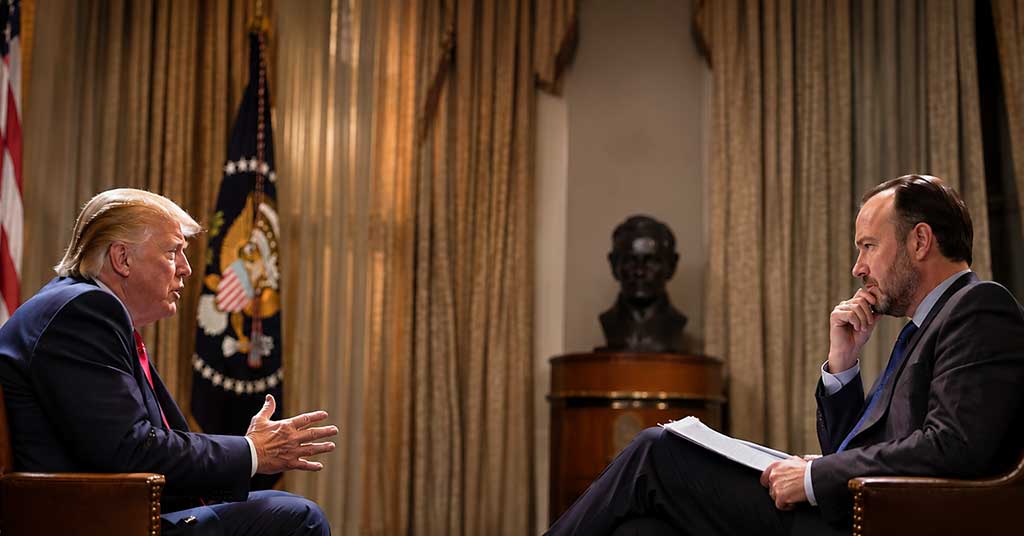
Douthat proves tough, respectful questioning forces real answers from Trump
U.S. President Donald Trump has been interviewed on many occasions at the White House. His most recent one may have broken new ground in terms of how to respectfully and properly engage with Trump going forward.
Most of Trump’s interviews would be placed in two broad categories. Discussions with Fox News (Laura Ingraham, Sean Hannity) and Newsmax (Rob Finnerty, Greg Kelly) had the occasional spirited moment but would be regarded as safe discussions on neutral ground. Conversely, Jim Acosta’s 2018 CNN interview, Jonathan Swan’s 2020 Axios on HBO interview and Kristen Welker’s 2026 Meet the Press interview on NBC were fiery and adversarial, but revealed little about the president’s thoughts about specific issues.
A tiny number of interviews would be regarded as interesting, engaging and revealing. The list includes: 60 Minutes’ Lesley Stahl in 2018 and 2020 on CBS, Bob Woodward’s on-the-record conversations for his 2020 book Rage, Ben Domenech’s 2025 interview for The Spectator and the president’s Q&A session with The Atlantic’s Ashley Parker, Michael Scherer and Jeffrey Goldberg in 2025.
These examples pale in comparison to Ross Douthat’s Nov. 8 interview with Trump on 60 Minutes. It’s in a class of its own. A master class, in fact.
Douthat is a conservative columnist/author who writes for The Free Press. He’s also worked for National Review, The Atlantic and The New York Times. He joined 60 Minutes as a correspondent in July, and has quickly become one of the news magazine’s most important voices.
Douthat had a short debut segment in September, and conducted engaging interviews with the two Michigan Senate candidates, Abdul El-Sayed (Democrat) and Mike Rogers (Republican).
The Trump interview was his pièce de résistance. Here are a few intriguing exchanges to help understand why.
Douthat asked Trump what would be the “one thing you would like to work with a Democratic majority on?” He replied, “I’d love to do something on immigration.” Douthat was understandably surprised and responded, “do you think immigration hurt you in the midterms?” The president said in part, “I think it both helped and hurt. I think I got an A+ for closing up the border. I get very high marks for getting the bad ones out. But I get hurt because we also took people that had good jobs, that—that created one violation, or breaking of the law, and that was that they came into the country illegally.”
When Douthat asked about Trump’s deportation policy and wondered if it went “too far.” The president said, “I think it might be too tough, yeah.”
Trump also told Douthat, “without us, Israel would not exist.” He would flesh out this position thusly, “Israel would not exist except for Donald Trump because we went in with those beautiful B2 Bombers more than a year ago, and we hit the three sites at—at the time.” Trump had no regrets about attacking Iran to ensure they didn’t have nuclear capacity, and was pleased to point out the U.S. had “decapitated their nuclear arsenal.”
The president wouldn’t say who he preferred to deal with in the Russia-Ukraine war. Douthat asked him point blank, “who do you trust more, President Putin or President Zelenskyy?” Trump’s response? “Well, I’d rather not say, but I get along with both. I believe that that war is going to end, and it’s gonna end soon. And the only reason it’s gonna end is because of me.”
He suggested “there is tremendous hatred between President Putin and President Zelenskyy,” noted the “disrespect” shown by Ukraine to Russia, but also stated, “nobody [has] been tougher on Russia than me.”
Douthat’s two most unique topics then followed.
First, they discussed UFOs. The president said, “I’m not too much of a believer, but I sat in the Oval Office, first term and a little bit second term, meeting with Air Force pilots that are really good, solid people. These are not people that you would say are conspiracy theorists … And they’ve told me things that are very strange.”
What have they alluded to? “They said that—in—in certain cases. They said yes, there’s something going on out there. Because they’re flying an F-22, which is the best there is, the fastest, the best plane that anyone’s ever seen. And something goes by them at three times their speed and it’s round. It’s not aerodynamic, it’s round.”
Next, they discussed the topic of death. “Let’s say you pass away, you’re entering the next life,” Douthat posed, “and all you have to do to enter paradise is feel love and forgiveness for James Comey, Nancy Pelosi, anyone who you have expressed hate for over the years. Do you think you can do it?” Trump’s response was remarkably forthright. “Well, then I wouldn’t be real, would I? I mean, if I said to you, sure, the easy answer to that is ‘Oh, yes, I could forgive.’”
Douthat asked for a more definitive response. Trump said, “The answer is no. I want to be honest, no. I think it would—,” which led to Douthat interjecting, “Before the judgment throne of God?” Trump responded without flinching, “Before the judgment. No, I think they were very bad people and—I dislike, I can use the word hate, I do hate some of my enemies.”
Douthat was able to engage with Trump by employing a tough, albeit respectful, tone and speaking style. He discussed issues with him rather than constantly playing the “gotcha” tactics other journalists have employed. His questions weren’t in the form of softballs, but they weren’t always hardballs. He did interrupt and speak over Trump at various points, but that’s often the best route to get a relatively direct response.
He asked some original questions, and received some of the president’s most original answers ever put on record.
The blueprint for conducting an interesting, engaging and revealing interview with Trump has been created. Will others emulate Douthat’s successful model? That’s difficult to say, but they would be wise to do so.
Michael Taube is a political commentator, Troy Media syndicated columnist and former speechwriter for Prime Minister Stephen Harper. He holds a master’s degree in comparative politics from the London School of Economics, lending academic rigour to his political insights.
Explore more on Journalism, Trump administration, U.S. politics
The views, opinions, and positions expressed by our columnists and contributors are solely their own and do not necessarily reflect those of our publication.
Troy Media empowers Canadian community news outlets by providing independent, insightful analysis and commentary. Our mission is to support local media in helping Canadians stay informed and engaged by delivering reliable content that strengthens community connections and deepens understanding across the country.

